Simon List
A Werewolf Thing: A Rejected Mate Werewolf RomanceSimon List is one of the novel’s connective characters, linking Saphira Richards’s school life to the werewolf pack and later linking the werewolf community to the vampire world through Amanda. He first appears as a courteous classmate who offers Saphira friendship, but his importance quickly deepens: he is a werewolf, belongs to the same pack as Ashton Smith, is Ashton’s cousin, and eventually becomes Amanda’s mate. Through Simon, the story presents loyalty as something that crosses both family and species boundaries, even as the prophecy makes those boundaries the basis of an impending war.
Identity and Introduction
Simon is introduced at school as a blond-haired, blue-eyed boy seated beside Saphira Richards. He speaks to her in a whisper, introduces himself, and identifies her correctly before extending his hand. The exchange gives Saphira an immediate point of contact in an unfamiliar environment. Unlike Ashton Smith, whose presence is associated with rejection and humiliation, Simon approaches her openly and makes friendship possible.
His knowledge of Saphira is not accidental. Simon explains that he is a werewolf and that recognizing another werewolf’s mate is easy for members of the species. He also knows Ashton’s schedule because Ashton is in the same pack and is his cousin. After comparing their timetables, Simon discovers that he and Saphira share nearly every class except first and last period. The practical detail of the schedules turns supernatural recognition into an ordinary school connection: Simon is both a member of the pack’s social structure and a teenager navigating classes, lunch, and new friendships.
Pack Membership and Loyalty
Simon’s family and pack affiliations give him information Saphira does not yet feel safe sharing. He knows Ashton closely enough to understand his movements, yet Saphira decides not to tell him about Ashton’s rejection. Her silence shows that Simon’s friendliness does not instantly erase the danger surrounding the mate bond. Still, Simon becomes the person who walks with her from the library to the cafeteria and sits with her and several of his pack’s best friends. Their welcome gives Saphira a social place at school at a moment when she feels isolated.
Simon therefore functions as a mediator between private distress and communal belonging. He does not merely identify Ashton as a relative; he brings Saphira into contact with the pack as a living community. His role contrasts with Ashton’s public image as a rebellious alpha’s son who parties, gets high, and changes girlfriends frequently. Simon’s first actions are quieter and more dependable: he introduces himself, shares information, accompanies Saphira, and helps her meet others.
The Mate Relationship with Amanda
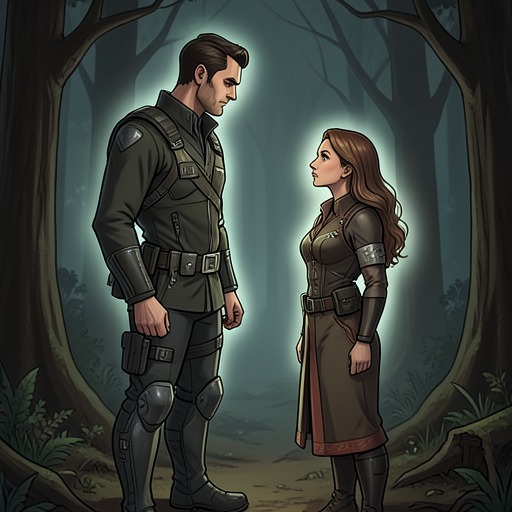
Simon’s most consequential relationship is with Amanda, a vampire. When Saphira’s father, Simon, and a girl enter a room, Ashton Smith recognizes the girl as a vampire and adopts a protective stance. Simon immediately mirrors that protective posture, but his protection is directed toward the vampire. The scene reveals that the vampire is Simon’s mate. Their bond is therefore established under conditions of species hostility rather than social approval.
The relationship is not presented as uncomplicated. Amanda challenges Simon when he tries to stop her from leaving, and he admits that he loves her. She responds skeptically, asking whether he has only begun to love her now, while Simon insists that he has loved her since the night he first saw her in the woods. The exchange gives the bond a history of emotional continuity, but it also shows that Amanda does not accept supernatural destiny as sufficient proof of trust. Simon must articulate commitment rather than rely only on the mate connection.
His protection of Amanda also reverses the expected alignment of the surrounding conflict. Simon is a werewolf, Amanda is a vampire, and the two races are destined to fight for dominance on the night when the sun is black and stars cross the sky. The prophecy further states that two hybrids of the same origin will lead the winning side. Against that collective division, Simon’s attachment to Amanda makes the personal bond politically disruptive: he protects the person his species is expected to regard as an enemy.
Crisis, Absence, and Apparent Death
Simon remains connected to the novel’s danger even when he is not the central actor in a scene. During the poisoning crisis, a doctor reports that an arrow striking Saphira Richards was coated with poison, prompting alarm from Ashton Smith. Simon is present in the surrounding network of protection and emergency, alongside Saphira’s father and Amanda, and his stance toward Amanda confirms that his loyalties are no longer reducible to werewolf pack identity.
Later, Simon is found in a brown-werewolf form after a search for signs of life. The discovery is starkly reduced to recognition: the apparently lifeless wolf is Simon. His condition places his body within the same violent world that threatens Saphira, Trevor Richards, Amanda, and the rival supernatural communities. The scene’s emphasis on identifying him rather than hearing him speak makes his absence itself significant. Simon’s identity is suddenly carried by the body others find, while the people around him must respond to what may have happened.
The surrounding narrative repeatedly treats bodily vulnerability as a communal crisis. Trevor Richards is described as incapacitated, and Saphira Richards is later warned that pregnancy prevents her from leading an army. Within that pattern, Simon’s apparent death intensifies the cost of the approaching conflict: pack membership, romantic attachment, and species allegiance all expose characters to physical consequences.
Narrative Role and Significance
Simon List begins as a threshold figure for Saphira Richards. He is the first school companion who openly explains the werewolf world, the person who identifies his connection to Ashton Smith, and the friend who brings her to his pack’s social circle. That introduction makes him a bridge between the ordinary setting of school and the hidden supernatural order governing Saphira’s life.
His later relationship with Amanda enlarges that function. Simon’s identity is defined by several overlapping affiliations: he is a werewolf, a pack member, Ashton’s cousin, Saphira’s ally, and Amanda’s beloved mate. The novel places these identities under pressure rather than allowing any one of them to settle the question of where his loyalty belongs. The vampire-werewolf prophecy seeks to turn species into destiny, but Simon’s conduct insists that intimacy can cross the boundary the war is built upon.
Simon’s importance consequently lies less in political authority than in relational resistance. He does not appear as the alpha who commands the coming struggle; instead, he exposes the instability of the categories that supposedly organize it. His friendship with Saphira creates belonging, his kinship with Ashton reveals the pack’s internal structure, and his love for Amanda challenges the separation between werewolves and vampires. When he is later found apparently dead, the danger of the larger conflict becomes personal and concrete. Simon’s trajectory turns a school introduction into a chain of loyalties whose consequences reach the prophecy, the species war, and the survival of those he protects.